First..........what is a Turret?
TurretFrom Wikipedia, the free encyclopedia
In architecture, a turret (from Italian: torretta, little tower; Latin: turris, tower) is a small tower that projects from the wall of a building such as a medieval castle. Turrets were used to provide a projecting defensive position allowing covering fire to the adjacent wall in the days of military fortification. As their military use faded, turrets were adopted for decorative purposes, as in the Scottish baronial style.
A turret might have a flat top with crenellations as in the picture, a pointed roof, or any other kind of top. It might contain a staircase if it projects higher than the building. However, a turret might not be any higher than the rest of the building; in this case it is part of a room, that can be simply walked into – see the turret of Chateau de Chaumont on this collection of turrets, which also illustrates a turret on a modern skyscraper.
A building may have both towers and turrets; turrets might be smaller or higher but the difference is generally considered to be that a turret projects from the edge of the building, rather than continuing to the ground. The size of a turret is therefore limited by technology, since it puts additional stresses on the structure of the building. It would traditionally be supported by a corbel.

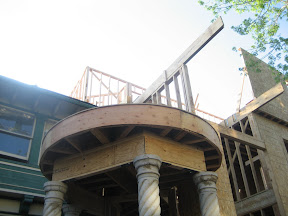
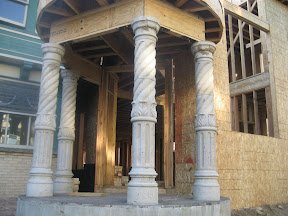
Copyright (c) 2007 Johnathan J. Stegeman.
Permission is granted to copy, distribute and/or modify this document
under the terms of the GNU Free Documentation License, Version 1.2
or any later version published by the Free Software Foundation;
with no Invariant Sections, no Front-Cover Texts, and no Back-Cover Texts.
A copy of the license is included in the section entitled "GNU
Free Documentation License".